
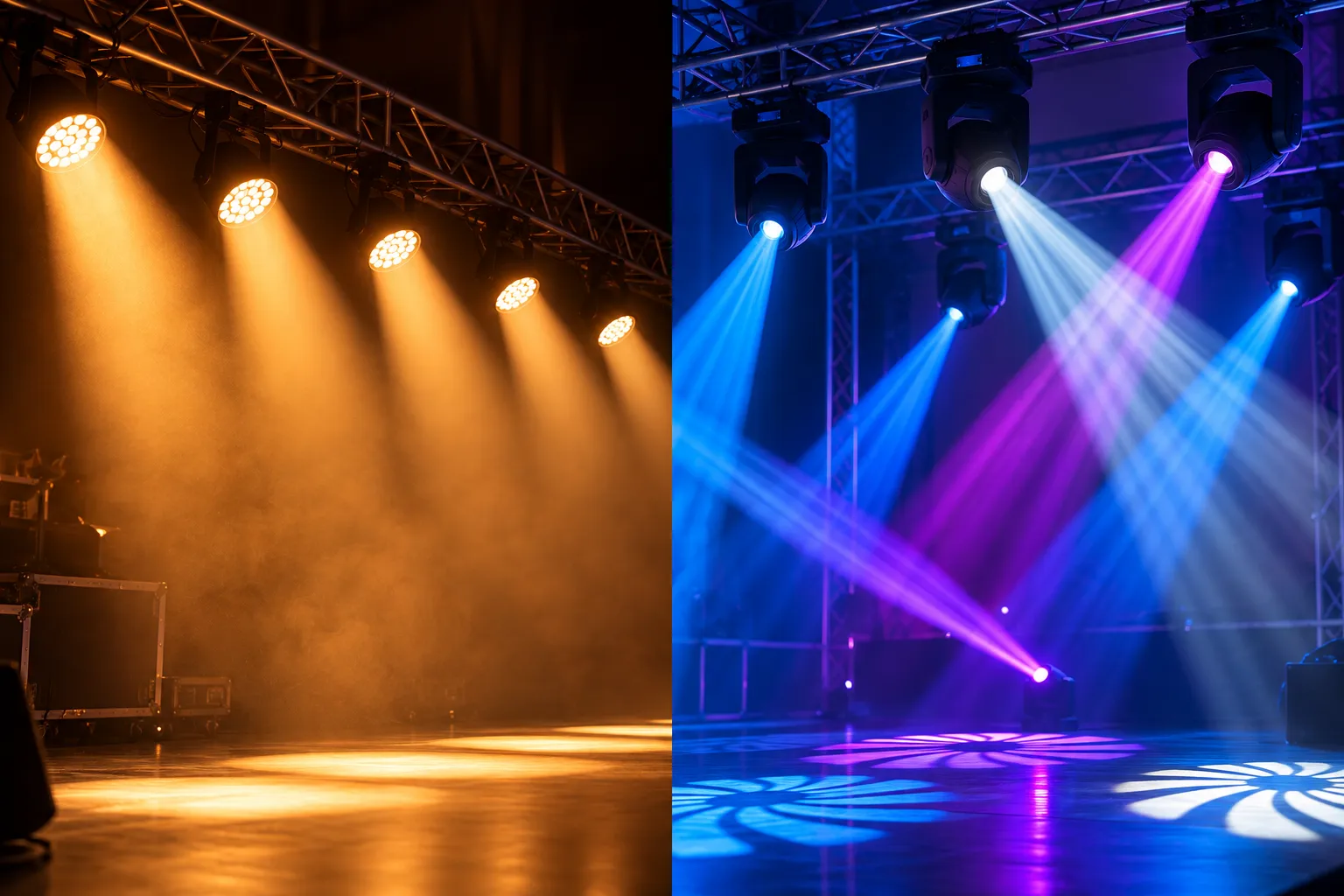

Professional lighting plays an essential role in concerts, theaters, clubs, corporate events, and other live productions. It does much more than simply illuminate a stage: it creates atmosphere, highlights performers, shapes the visual environment, and contributes to the overall audience experience.
When choosing stage lighting equipment, one of the most common questions is whether to invest in static fixtures or moving lights. The answer depends on the venue, event type, creative goals, budget, and required level of control.
Moving fixtures offer dynamic positioning and effects, while static fixtures are often better suited to consistent and repeatable illumination.
What Are Static Lights?
Static lights are fixtures that remain in a fixed position while operating. Once installed and aimed, they illuminate a specific area without automated pan or tilt movement.
They are commonly used for front lighting, stage washes, architectural lighting, studios, theaters, restaurants, and permanent installations.
The main advantages of static fixtures include:
- Simple operation
- Consistent illumination
- Easier installation
- Lower mechanical complexity
- Straightforward maintenance
- Cost-effective coverage of fixed areas
LED PAR fixtures, Fresnels, profiles, and wash fixtures can all be used as static lighting solutions depending on the application.
Moving lights, often called Moving Heads, use motorized mechanisms that allow the fixture to change its position remotely.
Depending on the model, a moving fixture may offer pan and tilt movement, adjustable beam angles, color mixing, gobos, zoom, prisms, focus, and other effects.
Moving lights are particularly useful for:
- Concerts
- Festivals
- Clubs
- DJ performances
- Large stages
- TV productions
- Corporate shows
Their biggest advantage is flexibility. A single moving fixture can illuminate different areas of a stage during the same performance without requiring manual repositioning.
Static fixtures are often the more efficient choice when the lighting positions remain fixed and consistent illumination is the main goal. Moving fixtures become more valuable when the production requires dynamic beams, repositioning, effects, and programmed scenes.
Which Is More Effective for Events?
There is no universal winner.
For a small event, restaurant, theater, or permanent stage, static fixtures may provide everything you need. They can deliver reliable front lighting, stage washes, and background illumination without adding unnecessary mechanical complexity.
For a concert, festival, nightclub, or dynamic show, moving lights can offer much greater creative flexibility. Their beams can move with the music, change direction during different scenes, and create visual movement across the venue.
However, professional lighting systems often combine both types. Static fixtures can provide the basic front and wash lighting, while moving heads add dynamic color, movement, beams, and effects.
What About Lasers?
Lasers are specialized visual-effect tools used in concerts, clubs, festivals, and large-scale productions.
Unlike conventional stage fixtures, laser systems can create highly concentrated beams, patterns, and striking aerial effects. They are usually used as an additional visual layer rather than as the only source of stage illumination.
When combined with moving lights and haze, lasers can create a highly immersive visual environment.
Smoke and Stage Effect Generators
Smoke and stage effect generators can significantly enhance the visual impact of lighting.
Haze and fog make beams visible in the air, allowing audiences to see the actual path of light rather than only the illuminated surface. This can make moving beams, laser effects, and other stage lighting elements appear much more dramatic.
These effects are particularly effective in concerts, clubs, festivals, and theatrical productions.
The Importance of Lighting Control Systems
Modern professional lighting depends not only on fixtures but also on how those fixtures are controlled.
Lighting control systems allow operators to manage multiple fixtures, create scenes, program movement, adjust colors and intensity, and synchronize lighting effects with a performance.
DMX512 is widely used for controlling stage lighting, while more advanced installations may also use network-based protocols such as Art-Net and sACN.
The more complex the lighting rig, the more important it becomes to select a control system that can handle the number and type of fixtures being used.
Vintage Lighting for Interior Design
Not every lighting project requires professional stage fixtures. For restaurants, hotels, cafés, lounges, and residential interiors, Vintage Lamps can provide a completely different visual character.
Vintage-style lighting can create a warm and decorative atmosphere while becoming an important part of the interior design itself.
Where to Choose the Right Lighting Equipment
Choosing professional lighting equipment is easier when you can compare different fixture types and understand how they work together.
A specialized Lighting Equipment Showroom can help you explore static fixtures, moving heads, lasers, effect generators, and lighting control systems in one place.
For larger projects, professional installation is equally important. A specialized Equipment Installation Showroom or technical team can help with system design, fixture positioning, cabling, control, and commissioning.